
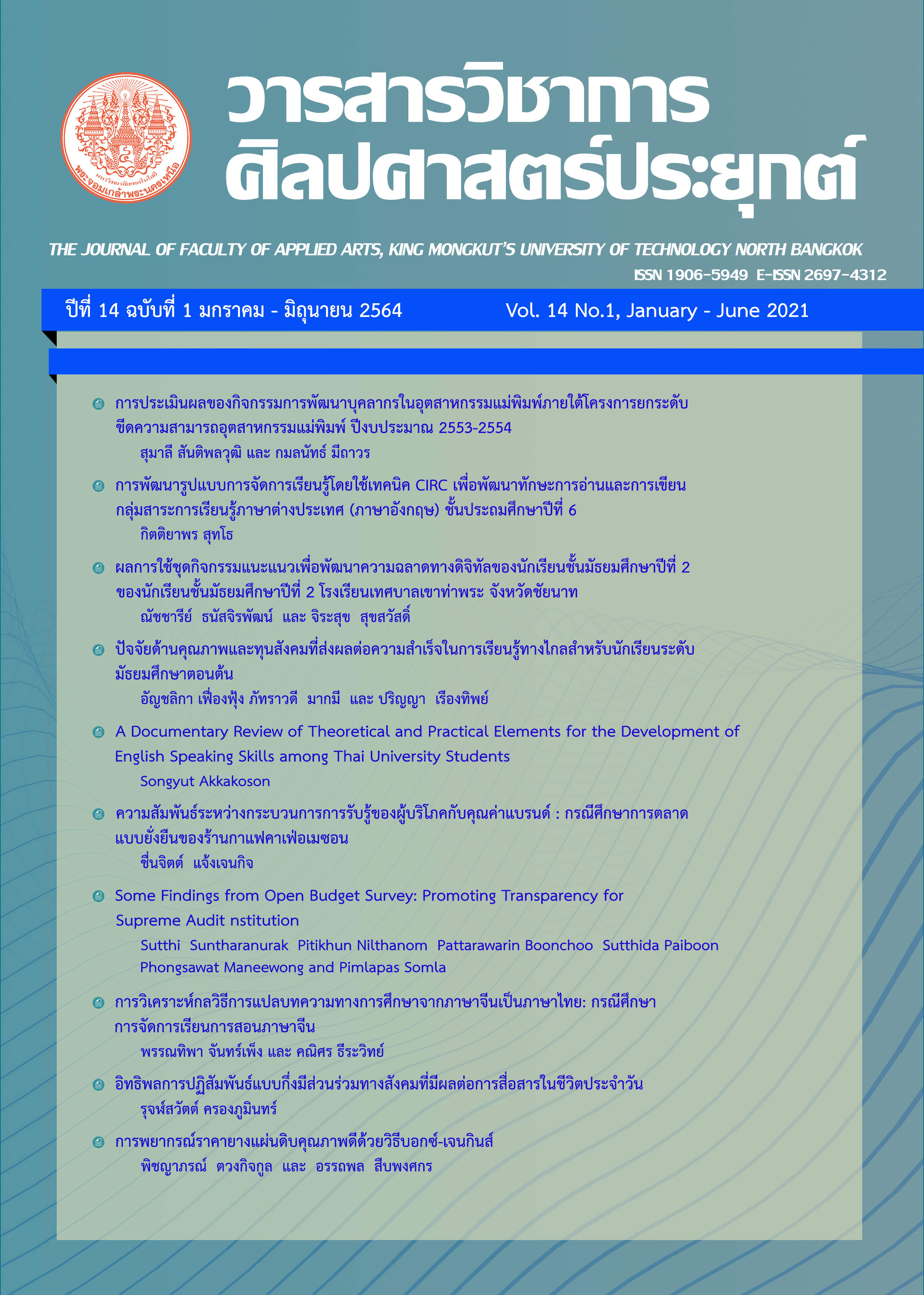
The Effects of Using a Guidance Activities Package to Develop Digital Intelligence Quotient of Mathayom Suksa II Students at Tessaban Khao Thaphra School in Chai Nat Province
Article Sidebar
Main Article Content
Abstract
The purposes of this research were 1) to compare digital intelligence quotient of the experimental group students before and after using a guidance activities package to develop digital intelligence quotient; and 2) to compare digital intelligence quotient of the experimental group students who used the guidance activities package to develop digital intelligence quotient with the counterpart digital intelligence quotient of the control group students who used a set of information. The research population consisted of 40 Mathayom Suksa II students of Tessaban Khoa Thaphra School in Chai Nat province during the first semester of the 2020 academic year. They were randomly assigned into an experimental group comprising 20students and a control group comprising 20 students. The research instruments were 1) a guidance activities package to develop digital intelligence quotient; 2) a set of information; and 3) a scale to assess digital intelligence quotient, with .90 reliability coefficient. The statistics for data analysis were the mean and standard deviation of population. The research findings were as follows: 1) the post-experiment digital intelligence quotient of the experimental group students, who used the guidance activities package to develop digital intelligence quotient, was significantly higher than their pre-experiment counterpart digital intelligence quotient; and 2) the level of digital intelligence quotient of the experimental group students, who used the guidance activities package to develop digital intelligence quotient, was significantly higher than the counterpart digital intelligence quotient level of the control group students who used the set of information.
Article Details

This work is licensed under a Creative Commons Attribution-NonCommercial-NoDerivatives 4.0 International License.
1.The articles published in the Journal of Faculty of Applied Arts are the copyright of the journal. The use of the contents, texts, opinions, pictures, tables or any parts of the articles to be published in any format for the commercial use must be officially allowed in a written form by the authorized person of the editorial team.
2.The opinion exists in each article is the author’s responsibility. The editorial team of the Journal of Faculty of Applied Arts (FAA lecturers, staff, and any personnel) will not take any responsibility on that. The author of each article is the only person who will take full responsibility for his or her own article.
References
กระทรวงเทคโนโลยีสารสนเทศและการสื่อสาร. (2559). DIGITAL THAILAND แผนพัฒนาดิจิทัลเศรษฐกิจและสังคม. กรุงเทพมหานคร: กระทรวงเทคโนโลยีสารสนเทศและการสื่อสาร.
ชนัญชิดา นามมา. (2558). ผลการใช้ชุดกิจกรรมแนะแนวเพื่อพัฒนาพฤติกรรมการใช้อินเตอร์เน็ตที่เหมาะสมของนักเรียน
ชั้นประถมศึกษาปีที่ 6 โรงเรียนอุดรคริสเตียนวิทยา จังหวัดอุดรธานี. (วิทยานิพนธ์ปริญญามหาบัณฑิต). มหาวิทยาลัยสุโขทัยธรรมาธิราช, นนทบุรี.
ณัฐกุล กิ่งแก้ว. (2558). ผลการใช้ชุดกิจกรรมแนะแนวต่อการควบคุมตนเองมีพฤติกรรมติดสมาร์ทโฟนของนักเรียน
ชั้นมัธยมศึกษาปีที่ 1 โรงเรียนสตรีภูเก็ต จังหวัดภูเก็ต. (วิทยานิพนธ์ปริญญามหาบัณฑิต). มหาวิทยาลัยสุโขทัยธรรมาธิราช, นนทบุรี.
ตะวัน แวงโสธรณ์, นิรนาท แสนสา, วัลภา สบายยิ่ง และรัญจวน คำวชิระพิทักษ์. (2562). ผลการใช้ชุดกิจกรรมแนะแนว
แบบบูรณาการเพื่อพัฒนาการให้อภัยของนักเรียนวัยรุ่นตอนต้น. วารสารศึกษาศาสตร์ มหาวิทยาลัยสุโขทัยธรรมาธิราช, 12(1), 55-70.
ธีรวัฒน์ รูปเหลี่ยม. (2560). การพัฒนาโปรแกรมเพื่อเสริมสร้างความฉลาดทางดิจิทัลของนักเรียนระดับประถมศึกษา. (วิทยานิพนธ์ปริญญามหาบัณฑิต). มหาวิทยาลัยมหาสารคาม, มหาสารคาม.
ปณิตา วรรณพิรุณ และ นำโชค วัฒนานัณ. (2560). ความฉลาดทางดิจิทัล. พัฒนาเทคนิคศึกษา, 29(102), 12-20.
พีรวิชญ์ คำเจริญ และ วีรพงษ์ พลนิกรกิจ. (2561). เด็กกับการรู้เท่าทันดิจิทัล. นวัตกรรมสื่อสารสังคม, 6(2), 22-31.
มูลนิธิอินเทอร์เน็ตร่วมพัฒนาไทย. (2562). แนวทางปกป้องคุ้มครองเด็กจากภัยออนไลน์. สืบค้นจาก https://www.healthymediahub.com/media/detail/คู่มือแนวทางปกป้องคุ้มครองเด็กจากภัยออนไลน์
วลัญชพร ทุ่งสง และ ลักขณา สริวัฒน์. (2562). การศึกษาความฉลาดทางดิจิทัลในระดับความเป็นพลเมืองดิจิทัลของนักเรียน ชั้นมัธยมศึกษาตอนต้น โรงเรียนสารคามวิทยาคม อำเภอเมือง จังหวัดมหาสารคาม. วารสารการบริหารและนิเทศการศึกษา มหาวิทยาลัยมหาสารคาม, 10(3), 19-34.
วันวิสา ชูการ. (2559). ผลการใช้ชุดกิจกรรมแนะแนวเพื่อพัฒนาการแสวงหาและการใช้สารสนเทศของนักเรียน
ชั้นมัธยมศึกษาปีที่ 3 โรงเรียนตรังคริสเตียนศึกษา จังหวัดตรัง. (วิทยานิพนธ์ปริญญามหาบัณฑิต). มหาวิทยาลัยสุโขทัยธรรมาธิราช, นนทบุรี.
สมร ทองดี และ ปราณี รามสูตร. (2545). หน่วยที่ 9 แนวคิดในการพัฒนากิจกรรมแนะแนว ใน ประมวลสาระชุดการพัฒนาเครื่องมือและกิจกรรมแนะแนว (พิมพ์ครั้งที่ 1). นนทบุรี: สาขาวิชาศึกษาศาสตร์ มหาวิทยาลัยสุโขทัยธรรมาธิราช.
สรานนท์ อินทนนท์. (2561). ความฉลาดทางดิจิทัล (DQ Digital Intelligence). (พิมพ์ครั้งที่ 1). กรุงเทพมหานคร: มูลนิธิส่งเสริมสื่อเด็กและเยาวชน (สสย).
สำนักงานพัฒนาธุรกรรมทางอิเล็กทรอนิกส์ (องค์การมหาชน). (2562). รายงานผลการสำรวจพฤติกรรมผู้ใช้อินเทอร์เน็ต
ในประเทศไทย ปี 2561. กรุงเทพมหานคร: สำนักยุทธศาสตร์.
สำนักงานส่งเสริมสังคมแห่งการเรียนรู้และคุณภาพเยาวชน (สสค.). (2559). ความฉลาดทางดิจิทัล (Digital Intelligence: DQ) ที่จำเป็นสำหรับเด็กในศตวรรษที่ 21. สืบค้นจาก http://www.qlf.or.th/ Home/Contents/1137
สำนักงานสถิติแห่งชาติ. (2561). สรุปผลที่สำคัญการสำรวจการมีการใช้เทคโนโลยีสารสนเทศและการสื่อสารในครัวเรือน พ.ศ.2561. กรุงเทพมหานคร: กองสถิติพยากรณ์.
สุพัตรา เขียวหวาน. (2556). ผลของการใช้ชุดกิจกรรมแนะแนวเพื่อพัฒนาทักษะการรู้สารสนเทศของนักเรียนชั้นมัธยมศึกษา
ปีที่ 1 โรงเรียนวัดเขมาภิรตาราม จังหวัดนนทบุรี. (วิทยานิพนธ์ปริญญามหาบัณฑิต). มหาวิทยาลัยสุโขทัยธรรมาธิราช, นนทบุรี.
สุลักขณา ใจองอาจ. (2561). ผลของโปรแกรมกิจกรรมแนะแนวตามแนวคิดการเรียนรู้แบบร่วมมือเพื่อพัฒนาการรู้เท่าทันสื่อของนักเรียนชั้นมัธยมศึกษาปีที่ 6 โรงเรียนบ้านแพรกประชาสรรค์. (รายงานการศึกษาค้นคว้าอิสระ ปริญญามหาบัณฑิต). มหาวิทยาลัยเกษตรศาสตร์, กรุงเทพมหานคร.
เสาวนีย์ สุขสำราญ. (2561). ผลการใช้ชุดกิจกรรมแนะแนวด้วยเทคนิคระดมสมองเพื่อพัฒนาความสามารถในการแก้ปัญหาอย่างสร้างสรร์ของนักเรียนชั้นประถมศึกษาปีที่ 2 โรงเรียนเทศบาล 4 (อุดมวิทย์สมใจ) จังหวัดปราจีนบุรี. วารสารศึกษาศาสตร์ มหาวิทยาลัยสุโขทัยธรรมาธิราช, 11(2), 43-55.
DQ Institute. (2019). DQ Global Standards Report 2019. Retrieved from https://www.dqinstitute.org/dq-framework
DQ Institute. (2017). The top 8 Empowerments of DQ Education. Digital Intelligence Quotient Impact (Part2), p. 3-4. Retrieved from https://www.dqinstitute.org/DQ-Impact-Report-PART2.pdf
Stiakakis, E., Liapis, Y. & Vlachopoulou, M. (2019). Developing an understanding of digital intelligence as a prerequisiste of digital competence. Paper presented at The 13th Mediterranean Conference on Information Systems (MCIS), Naples, Italy. Abstract retrieved from https://aisel.aisnet.org/mcis 2019/27
