
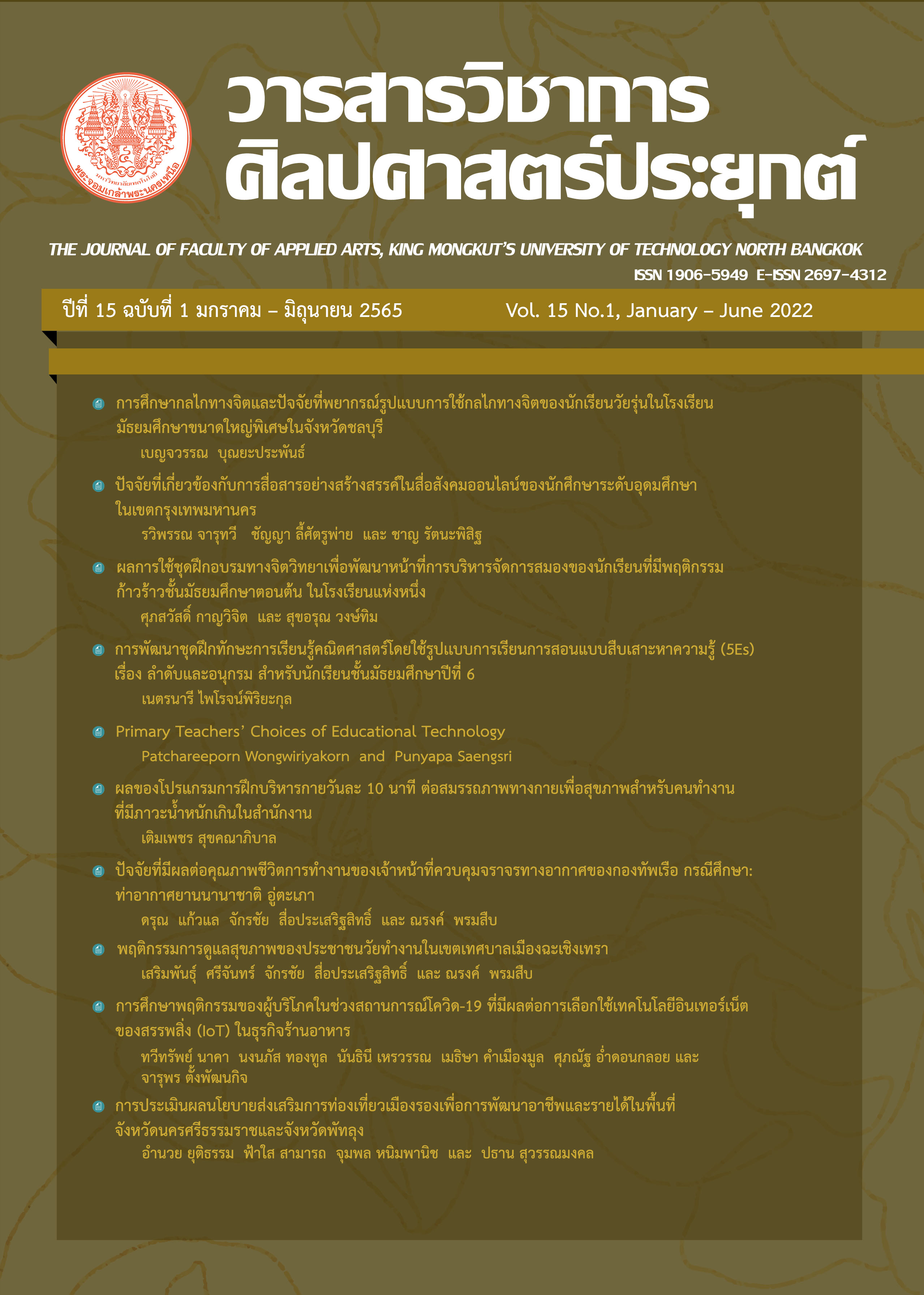
Factors Affecting the Use of Internet of Things (IoT) Technology in the Restaurant Industry during COVID-19 Situation
Article Sidebar
Main Article Content
Abstract
This research is to study consumer behavior, choosing IoT technology in the restaurant industry during COVID- 19 situation. The study factor was superior functionality, aesthetic appeal, ease of use, and presence of IoT technology that influence continuance intentions and word-of-mouth intentions. The tool for collecting data was an online questionnaire with populations in the Bangkok Metropolitan Region who had experience in using IoT technology in the restaurant industry during COVID- 19 epidemic situation. The sample was obtained using the Cochran and obtained 514 samples that could be analyzed. The statistics used in the analysis were mean, standard deviation, correlation coefficient, and multiple regression analysis statistically significant level of .05. The result showed that all independent variable four factors influence the dependent variable with the mediator variable to get involved. The presence factor had the most influence on the continuance intentions factor at 69.80 percentage, but when the co-creation experience factor was added as a mediator variable, the value was reduced to 32.3 percentage. In addition, the co-creation experience factor also influenced word-of-mouth intentions with the continuance intentions factor as a mediator variable (81.6 percentage).
Article Details

This work is licensed under a Creative Commons Attribution-NonCommercial-NoDerivatives 4.0 International License.
1.The articles published in the Journal of Faculty of Applied Arts are the copyright of the journal. The use of the contents, texts, opinions, pictures, tables or any parts of the articles to be published in any format for the commercial use must be officially allowed in a written form by the authorized person of the editorial team.
2.The opinion exists in each article is the author’s responsibility. The editorial team of the Journal of Faculty of Applied Arts (FAA lecturers, staff, and any personnel) will not take any responsibility on that. The author of each article is the only person who will take full responsibility for his or her own article.
References
Ashton, K. (2009). That ‘internet of things’ thing. RFID journal, 22(7), 97-114.
Balaji, M. S., and Roy, S. K. (2017). Value co-creation with Internet of things technology in the retail industry. Journal of Marketing Management, 33(1-2), 7-31.
Bezos, J. (2018). The Journey to Creating Amazing Customer Experiences. Retrieved from https://digitalbusinessblog. wordpress.com/2018/01/17/if-you-make-customers-unhappy-in-the-physical-world-they-might-each-tell-6-friends-if-you-make-customers-unhappy-on-the-internet-they-can-each-tell-6000-friends-jeff-bezos/
Bhattacherjee, A., (2001). An empirical analysis of the antecedents of electronic commerce service continuance. Decision Support Systems, 32(2), 201–214.
Bolton, R. N., Gustafsson, A., McColl-Kennedy, J., Sirianni, N. J., and Tse, D. K. (2014). Small details that make big differences: A radical approach to consumption experience as a firm's differentiating strategy. Journal of Service Management, 25(2), 253-274.
Chitturi, R., Raghunathan, R., and Mahajan, V. (2008). Delight by design: The role of hedonic versus utilitarian benefits. Journal of marketing, 72(3), 48-63.
Cobos, L. (2017). Determinants of continuance intention and word of mouth for hotel branded mobile app users (Doctoral Thesis, University of Central Florida, USA). Retrieved from https://stars.library.ucf.edu/ cgi/viewcontent.cgi?article=6719&context=etd
Cochran, W. G. (1977). Sompling Techniques (3rd ed.). New York: Wiley.
Courtland, L. B., & William, F. A. (1984). Contemporary Advertising. Journal of Marketing, 48(2), 101-103.
Davis, F. D. (1989). Perceived usefulness, perceived ease of use, and user acceptance of information technology. MIS Quarterly, 13(3), 319–340.
Filieri, R., and Lin, Z. (2017). The role of aesthetic, cultural, utilitarian and branding factors in young Chinese consumers repurchase intention of smartphone brands. Computers in Human Behavior, 67, 139-150.
Fishbein, M., and Ajzen, I. (1975). Belief, attitude, intentions, and behaviour: An introduction to theory and research. Boston, MA: Addison-Wesley.
Gefen, D., and Straub, D.W. (2003). Managing user trust in B2C e-Services. e-Service Journal, 2(2), 7-24.
Gubbi, J., Buyya, R., Marusic, S., and Palaniswami, M. (2013). Internet of things (IoT): A vision, architectural elements, and future directions. Future Generation Computer Systems, 29(7), 1645–1660.
Gunawardena, C. N. (1995). Social presence theory and implications for interaction and collaborative learning in computer conferences. International journal of educational telecommunications, 1(2), 147-166.
Hair, J. F., Black, W. C., Robin, B. J. and Anderson, R. E. (2014). Multivariate data analysis. (7th ed.). Harlow: Pearson Education Limited.
Hamid, A. A., Razak, F. Z. A., Bakar, A. A., and Abdullah, W. S. W. (2016). The effects of perceived usefulness and perceived ease of use on continuance intention to use e-government. Procedia Economics and Finance, 35, 644-649.
Hansen, J., Saridakis, G., and Benson, V. (2017). Risk, trust, and the interaction of perceived ease of use and behavioral control in predicting consumers’ use of social media for transactions.. Retrieved from https://www.researchgate.net/publication/320994032_Risk_Trust_and_the_Interaction_of_Perceived_Ease_of_Use_and_Behavioral_Control_in_Predicting_Consumers'_Use_of_Social_Media_for_Transactios
Hassanein, K., and Head, M. (2007). Manipulating perceived social presence through the web interface and its impact on attitude towards online shopping. International Journal of Human-Computer Studies, 65(8), 689-708.
Hoffman, D. L., and Novak, T. P. (2015). Emergent Experience and the Consumer in the Smart Home Assemblage and the Internet of Things. Retrieved from
Huang, M., Cai, F., Tsang, A. S., and Zhou, N. (2011). Making your online voice loud: the critical role of WOM information. European Journal of Marketing, 7/8(45), 1277-1297.
Huang, Y. C., Yang, M., and Wang, Y. C. (2014). Effects of green brand on green Purchase intention. Marketing Intelligence & Planning, 32(3), 250–268.
Iansiti, M., and Lakhani, K. R. (2014). Digital ubiquity: How connections, sensors, and data are revolutionizing business (digest summary). Harvard Business Review, 92(11), 91–99.
Kasikornresearch. (2020). Restaurant Business, 2020: Turnover to Decline by THB26.5-36.5 billion due to COVID-19 Fears (Current Issue No.3090). Retrieved from https://www.kasikornresearch.com/EN/analysis/k-econ/business/Pages/z3090.aspx
Lavie, T., and Tractinsky, N. (2004). Assessing dimensions of perceived visual aesthetics of web sites. International journal of human-computer studies, 60(3), 269-298.
Lemeshow, S., Hosmer, D. W., Klar, J., Lwanga, S. K., and World Health Organization. (1990). Adequacy of sample size in health studies. Technology and Its Impact on Consumer Behavior, 15(1), 11–48.
Likert, R. (1970). A technique for the measurement of attitudes. In G.F. Summers (Ed.), Attitude measurement (pp.149-158). London: Kershaw Publishing Company.
Mencarelli, R., and Rivière, A. (2014). Perceived value in B2B and B2C: A comparative approach and cross-fertilization. Marketing Theory, 15(2), 201–210.
Mukerjee, K. (2020). Impact of self-service technologies in retail banking on cross-buying and word-of-mouth. International Journal of Retail & Distribution Management, 5(48), 485-500. doi: 10.1108/IJRDM-08-2019-0261
Ogonowski, A., Montandon, A., Botha, E., & Reyneke, M. (2014). Should new online stores invest in social presence elements? The effect of social presence on initial trust formation. Journal of Retailing and Consumer Services, 21(4), 482-491.
Ozturk, A. B., Nusair, K., Okumus, F., & Hua, N. (2016). The role of utilitarian and hedonic values on users’ continued usage intention in a mobile hotel booking environment. International Journal of Hospitality Management, 57, 106-115.
Pine, B. J., & Gilmore, J. H. (1998). Welcome to the experience economy. Harvard Business Review, July-August, 98-105.
Preacher, K. J., & Hayes, A. F. (2008). Asymptotic and resampling strategies for assessing and comparing indirect effects in multiple mediator models. Behaviour Research Methods, 4(3), 879–889.
Roy, S. K., Balaji, M. S., Quazi, A., & Quaddus, M. (2018). Predictors of customer acceptance of and resistance to smart technologies in the retail sector. Journal of Retailing and Consumer Services, 42, 147-160.
Roy, S. K., Singh, G., Hope, M., Nguyen, B., & Harrigan, P. (2019). The rise of smart consumers: role of smart service scape and smart consumer experience co-creation. Journal of Marketing Management, 35(15-16), 1480-1513.
Sheng, M. L., & Teo, T. S. (2012). Product attributes and brand equity in the mobile domain: The mediating role of customer experience. International Journal of Information Management, 32(2), 139-146.
Shin, D., Song, J. H., & Biswas, A. (2014). Electronic word-of-mouth (eWOM) generation in newmedia platforms: The role of regulatory focus and collective dissonance. Marketing Letters, 25(2), 153–165.
Teo, T., Fan, X., & Du, J. (2015). Technology acceptance among pre-service teachers: Does gender matter. Australasian Journal of Educational Technology, 31(3), 235-251.
Tsai, C. T. S., & Wang, Y. C. (2017). Experiential value in branding food tourism. Journal of Destination Marketing & Management, 6(1), 56–65.
Van der Heijden, B. (2002). Prerequisites to guarantee life‐long employability. Personnel review, 1(31), 44-61. doi: 10.1108/00483480210412418
Vargo, S. L., & Lusch, R. F. (2008). Service-dominant logic: Continuing the evolution. Journal of the Academy of Marketing Science, 36(1), 1–10.
Waritsara Sonchit (2016). Online Purchase Intention of Goods or Service Through Smartphone. NRRU Community Research Journal, 10(1), 45-52.
Weinberg, B. D., Milne, G. R., Andonova, Y. G., & Hajjat, F. M. (2015). Internet of things: Convenience vs. privacy and secrecy. Business Horizons, 58(6), 615–624.
Xavier, W.J.L. & Summer, G.Y.S. (2009). Viral Marketing Communication: The Internet Word-of-Mouth: A Study on Consumer Perception and Consumer Response (Unpublished Master thesis), Blekinge Institute of Technology, Sweden.
