
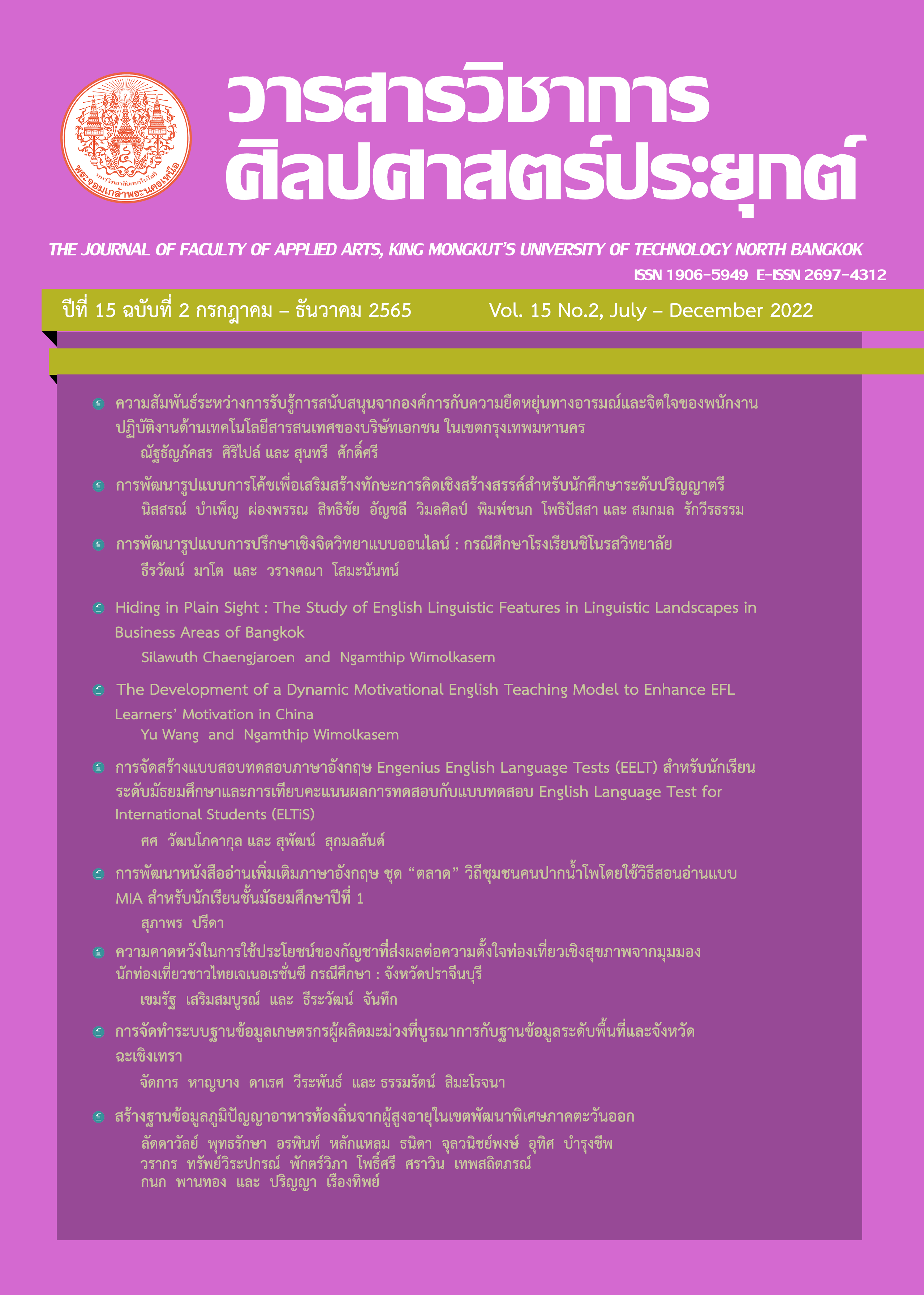
การจัดสร้างแบบสอบทดสอบภาษาอังกฤษ Engenius English Language Tests (EELT) สำหรับนักเรียนระดับมัธยมศึกษาและการเทียบคะแนนผลการทดสอบกับแบบทดสอบ English Language Test for International Students (ELTiS)
Article Sidebar
Main Article Content
บทคัดย่อ
การเทียบคะแนนของแบบทดสอบที่สร้างขึ้นใหม่กับแบบทดสอบมาตรฐานที่มีจำนวนจำกัดเป็นสิ่งที่สำคัญมากเพื่อความปลอดภัยของแบบทดสอบ และความน่าเชื่อถือของผลการสอบ การวิจัยครั้งนี้มีวัตถุประสงค์เพื่อจัดสร้างแบบทดสอบ Engenius English Language Test (EELT) สำหรับนักเรียนระดับมัธยมศึกษาชั้นปีที่ 1-6 ให้เป็นแบบทดสอบมาตรฐานในระดับสากลจำนวน 6 ชุดที่คู่ขนานจริง กับแบบทดสอบชุดเดิมคือ แบบทดสอบ English Language Test for International Students (ELTiS) และเพื่อสร้างตารางเทียบคะแนนของแบบทดสอบทั้งสองด้วย 2 วิธี คือ เทียบตำแหน่งเปอร์เซ็นต์ไทล์ และวิธีการถดถอยเชิงเส้นตรง กลุ่มตัวอย่างคือ ผู้สอบแบบทดสอบแต่ละชุดมี 300 คน มาจากนักเรียนแต่ละระดับชั้น 50 คน รวมเป็นทั้งสิ้น 1,800 คน ซึ่งได้มาจากการสุ่มอย่างง่ายจากผู้ที่มาสมัครสอบโดยไม่เสียค่าใช้จ่าย แบบทดสอบ EELT ชุดใหม่ทั้ง 6 ชุดสร้างจากตารางกำหนดลักษณะเฉพาะของแบบทดสอบ ELTiS และตรวจสอบความตรงเชิงเนื้อหามาแล้วว่ามีคุณภาพอยู่ในระดับสูงมากโดยผู้เชี่ยวชาญด้านการเรียนการสอน และการวัดและประเมินผลทางภาษาอังกฤษ 5 ท่าน และเก็บข้อมูลจากการจัดสอบแบบใช้ผู้สอบกลุ่มเดียวและสลับแบบทดสอบ แล้ววิเคราะห์ข้อมูลด้วย Independent Samples t-test วิธีเทียบคะแนนเชิงเส้นตรงของเลอวีน สหสัมพันธ์แบบเพียร์สัน วิธีเทียบคะแนนโดยใช้ตำแหน่งของคะแนน และวิธีเทียบคะแนนเชิงเส้นตรงการถดถอย ผลการวิจัยพบว่า แบบทดสอบ EELT ชุดที่ 1, 2 และ 4 เป็นแบบทดสอบคู่ขนานจริงกับแบบทดสอบ ELTiS แต่แบบทดสอบ EELT ชุดที่ 3, 5 และ 6 เป็นแบบ ทดสอบคู่ขนานเทียม และได้ตารางเทียบคะแนนระหว่างแบบทดสอบ EELT กับ ELTiS จำนวน 2 ตารางจากผลการเทียบคะแนน 2 วิธี ผลของการวิจัยได้แบบทดสอบใหม่ 3 ชุดที่สามารถใช้แทนแบบทดสอบมาตรฐานได้ ส่วนอีก 3 ชุดควรต้องได้รับการปรับปรุงแก้ไขบางอย่างก่อนที่จะนำไปใช้จริงต่อไป
Article Details

อนุญาตภายใต้เงื่อนไข Creative Commons Attribution-NonCommercial-NoDerivatives 4.0 International License.
1.บทความที่ตีพิมพ์เป็นลิขสิทธิ์ของวารสารวิชาการศิลปศาสตร์ประยุกต์ การนำเนื้อหา ข้อความหรือข้อคิดเห็น รูปภาพ ตาราง ของบทความไปจัดพิมพ์เผยแพร่ในรูปแบบ ต่าง ๆ เพื่อใช้ประโยชน์ในเชิงพาณิชย์ ต้องได้รับอนุญาตจากกองบรรณาธิการวารสารอย่างเป็นลายลักษณ์อักษร
2.ข้อความที่ปรากฏในบทความแต่ละเรื่อง เป็นความคิดเห็นส่วนตัวของผู้เขียนแต่ละท่านไม่เกี่ยวข้องกับวารสารวิชาการศิลปศาสตร์ประยุกต์ และบุคลากร คณาจารย์ท่านอื่น ๆ ในวารสารฯ แต่อย่างใด ความรับผิดชอบองค์ประกอบทั้งหมดของบทความแต่ละเรื่องเป็นของผู้เขียนแต่ละท่าน หากมีความผิดพลาดใด ๆ ผู้เขียนแต่ละท่านจะรับผิดชอบบทความของตนเองแต่ผู้เดียว
เอกสารอ้างอิง
กองทุนเพื่อความเสมอภาคทางการศึกษา. (2565). จำนวนนักเรียน จำแนกตามเพศและช่วงชั้น ปีการศึกษา 2564. สืบค้นจาก https://isee.eef.or.th/screen/studentdata/student.html
คุรุสภา. (2563). หลักเกณฑ์การเทียบเคียงผลการทดสอบและประเมินสมรรถนะทางวิชาชีพครูด้านความรู้และประสบการณ์วิชาชีพ ตามมาตรฐานวิชาชีพครู ประจำปี พ.ศ. 2563-2565. สืบค้นจาก https://www.ksp.or.th/ksp2018/wp-content/uploads/2020/11/Announce-of-teachers-licence-test.pdf
สรัญญา จันทร์ชูสกุล, ไชยยศ ไพวิทยศิริธรรม และยุวรี ผลพันธิน. (2560). การเปรียบเทียบคุณภาพของการปรับเทียบคะแนนสอบภาษาอังกฤษระหว่างวิธีอิควิเปอร์เซ็นไตล์ วิธีเชิงเส้นตรง และวิธีสมการถดถอย. วารสาร Veridian E-Journal, Silpakorn University, 10(2), 2444-2455. สืบค้นจาก https://he02.tci-thaijo.org/index.php/Veridian-E-Journal/article/view/103591/83359
สุพัฒน์ สุกมลสันต์. (2560). การเทียบคะแนนแถบระดับความสามารถของแบบทดสอบวัดสมิทธิภาพทางภาษาอังกฤษชุดใหม่ของมหาวิทยาลัยแม่โจ้ (New MJU-TEP) กับระดับของ CEFR. (รายงานวิจัย). เชียงใหม่ : ศูนย์ภาษา มหาวิทยาลัยแม่โจ้.
สำนักงานเลขาธิการสภาการศึกษา. (2560). แผนการศึกษาแห่งชาติ พ.ศ. 2560-2579. กรุงเทพมหานคร : สำนักพิมพ์พริกหวานกราฟฟิค จำกัด. สืบค้นจาก http://www.lampang.go.th/public60/EducationPlan2.pdf
Albano, A. (2010). Statistical equating methods. Retrieved from http://citeseerx.ist.psu.edu/viewdoc/download?doi=10.1.1.168.826&rep=rep1&type=pdf
Arıkan, C. A. & Gelbal, S. (2018). A comparison of traditional and Kernel equating methods. International Journal of Assessment Tools in Education, 5(3), 417–427. Retrieved from https://dergipark.org.tr/tr/pub/ijate/issue/37036/409826
Baghaei, P. (2010). Test score equating and fairness in language assessment. Journal of English Language Studies, 1(3), 113-128.
Brennan, R. L., Wang, T., Kim, S. & Seol, J. (2009). Equating recipes (Version 1) [Computer software and manual] (CASMA Monograph No. 1). Iowa City, IA : Center for Advanced Studies in Measurement and Assessment, The University of Iowa. Retrieved from http://www.education.uiowa.edu/casma
Council of Europe. (2020). Common European framework of reference for languages : Learning, teaching, Assessment—Companion volume. Strasbourg : Council of Europe Publishing. Retrieved from www.coe.int/lang-cefr
Cui, Z. & Kolen, M. J. (2009). Evaluation of two new smoothing methods in equating : The cubic B-spline presmoothing method and the direct presmoothing method. Journal of Educational Measurement, 46(2), 135–158.
Dorans, N. J. (2004). Equating, concordance, and expectation. Applied Psychological Measurement, 28(4), 227-246.
Fairbank, B. A. Jr. (1987). The use of presmoothing and postsmoothing to increase the precision of equipercentile equating. Journal of Applied Psychological Measurement, 11(3), 245-262. Retrieved from https://conservancy.umn.edu/bitstream/handle/11299/104061/v11n3p245.pdf?sequence=1
Grant, M. C., Zhang, L. & Damiano, I. (2009). An evaluation of Kernel equating : Parallel equating with classical methods in the SAT subject tests program (Research Report ETS RR–09-06). Princeton, New Jersey : Educational Testing Service.
Gubes, N. & Uyar, S. (2020). Comparing performance of different equating methods in presence and absence of DIF items in Anchor Test. International Journal of Progressive Education, 16(3), 111-122.
Hanson, B. A. (1991). A comparison of bivariate smoothing methods in common-Item equipercentile equating. Journal of Applied Psychological Measurement, 15(4), 391-408. Retrieved from https://conservancy.umn.edu/bitstream/handle/11299/114469/1/v15n4p391.pdf
Hanson, B. A., Zeng, L. & Colton, D. (1994). A comparison of presmoothing and postsmoothing methods in equipercentile equating (ACT Research Report Series 94-4). Iowa : The American College Testing Program. Retrieved from https://www.act.org/content/dam/act/unsecured/documents/ACT_RR94-04.pdf
Heh, V. K. (2007). Equating accuracy using small samples in the random group design (Doctoral Dissertation). Ohio, USA : The College of Education of Ohio University. Retrieved from https://etd.ohiolink.edu/!etd.sendfile?accession=ohiou1178299995&disposition=inline
Hopkins, W. G. (2002). A new view of statistics : Correlation coefficients. Retrieved from https://www. sportsci.org/resource/stats/effectmag.html
Kolen, M. J. & Brennan, R. J. (2004). Test equating, scaling, and linking: Methods and practices (2nd ed.). New York : Springer-Verlag.
Kontos, D. L. (2007). Investigation of validity, reliability, and practice effects of the immediate postconcussion assessment and cognitive test (impact) and traditional paper-pencil neuropsychological tests (Master’s thesis). North Carolina, USA : University of North Carolina at Chapel Hill. Retrieved from https://doi.org/10.17615/ht0k-ge23
Liu, J. & Low, A. C. (2008). A comparison of the Kernel equating method with traditional equating methods using SAT data. Journal of Educational Measurement, 45(4), 309–323. Retrieved from https://doi.org/10.1111/j.1745-3984.2008.00067.x
Livingston, S. (1992). Small-sample equating with log-linear smoothing (Research Report No. RR-92-4). Princeton, New Jersey : Educational Testing Service. Retrieved from https://doi.org/10.1002/j.2333-8504.1992.tb01434.x
Lord, F. M. & Wingersky, M. S. (1984). Comparison of IRT true-Score and equipercentile observed-score "equatings". Journal of Psychological Measurement, 8(4), 453-461.
Lord, F. M. & Novick, M. R. (1968). Statistical theories of mental test scores. Reading, MA : Addison-Wesley.
Moses, T. & Liu, J. (2011). Smoothing and equating methods applied to different types of test scoredistributions and evaluated with respect to multiple equating criteria (Research Report ETS RR–11-20). Princeton, New Jersey : Educational Testing Service. Retrieved from https://files.eric.ed.gov/fulltext/ED523686.pdf
Phillips, S. E. (1983). Comparison of equi-percentile and response theory equating when the scaling test method is applied to multilevel achievement batter. Applied Psychological Measurement, 7(3), 267-281.
Rapp, J. (1999). Multilevel linear and equi-percentile methods for equating PET. National Institute for Testing and Evaluation. Retrieved from https://www.nite.org.il/wp-content/uploads/2018/06/e266.pdf
Rovinelli, R. J. & Hambleton, R. K. (1977). On the use of content specialists in the assessment of criterion-referenced test item validity. Tijdschrift voor Onderwijsresearch, 2(2), 49–60. Retrieved from https://files.eric.ed.gov/fulltext/ED121845.pdf
Shah, C. H. & Brown, J. D. (2020). Reliability and validity of the short-form 12 item version 2 (SF−12v2) health-related quality of life survey and disutilities associated with relevant conditions in the U.S. older adult population. Journal of Clinical Medicine, 9(3), 661. Retrieved from https://www.mdpi.com/2077-0383/9/3/661
Shin, M. (2015). An investigation of subtest score equating methods under classical test theory and item response theory frameworks (Doctoral dissertation). Massachusetts, USA : University of Massachusetts Amherst. Retrieved from https://scholarworks.umass.edu/cgi/viewcontent.cgi?article=1397&context=dissertations_2
Turner, R. C. & Carlson, L. (2003). Indexes of item-objective congruence for multidimensional items. International Journal of Testing, 3(2), 163-171. Retrieved from https://www.tandfonline.com/doi/abs/10.1207/S15327574IJT0302_5
von Davier, A. A. et al. (2006). An evaluation of the kernel equating method: a special study with pseudotests constructed from real test data (Research Report RR-06-02). Princeton, New Jersey : Educational Testing Service. Retrieved from https://files.eric.ed.gov/fulltext/EJ1111405.pdf
Wiberg, M. (2021). On the use of different linkage plans with different observed-score equipercentile equating methods. Practical Assessment, Research & Evaluation, 26(23), 1-16. Retrieved from https://scholarworks.umass.edu/pare/vol26/iss1/23
Yu, C. H. & Osborn Popp, S. E. (2005). Test equating by common items and common subjects : concepts and applications. Practical Assessment Research and Evaluation, 10(4), 1–19.
