
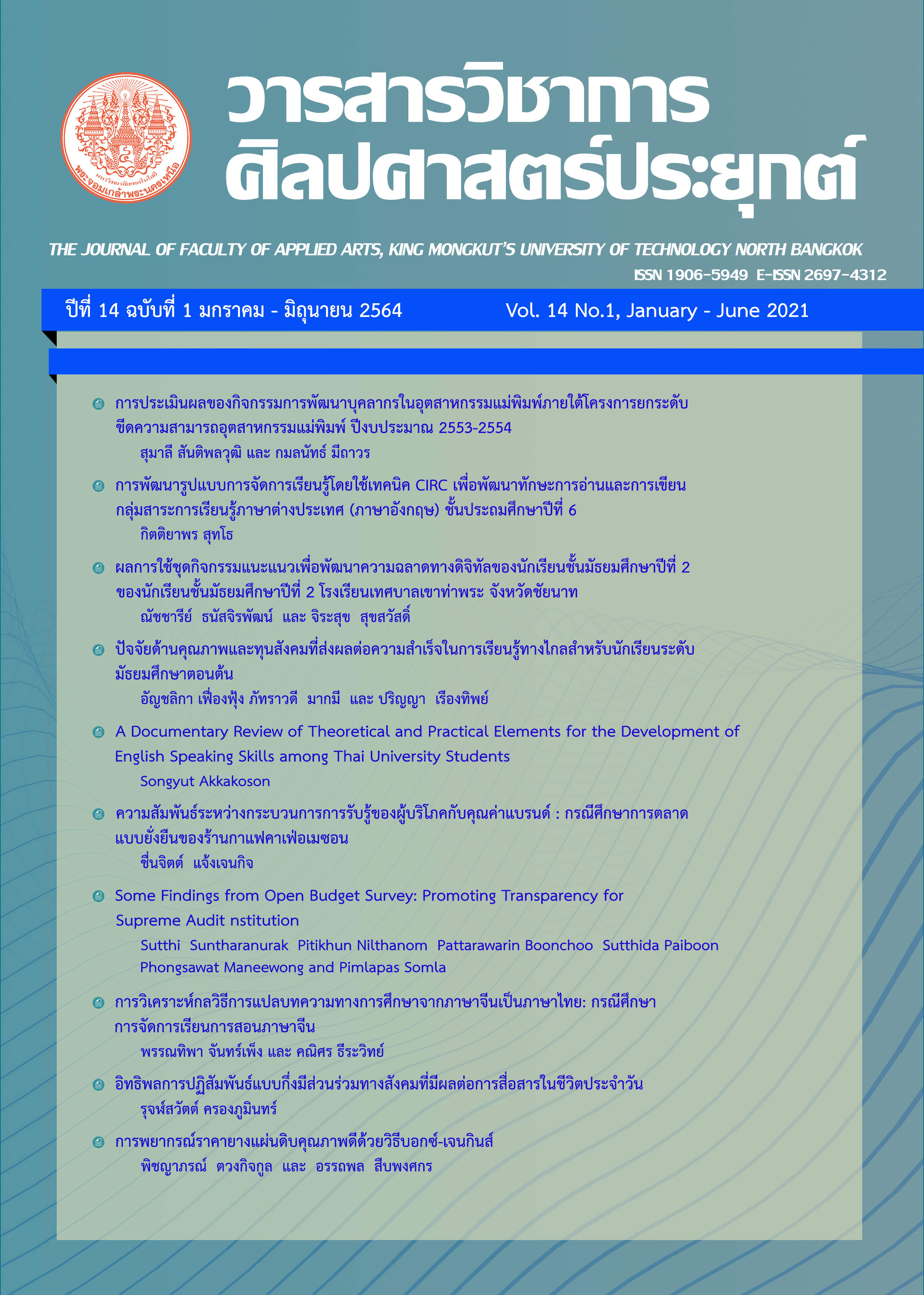
An Analysis of Chinese-Thai Translation Strategies in Academic Articles:A Case Study of Chinese Language Teaching
Article Sidebar
Main Article Content
Abstract
The purposes of this study were to 1) analyze and synthesize Chinese-Thai translation of scholarly articles from the book, “International Chinese Teaching Cases and Analyses”; and 2) identify strategies used to translate Chinese- language. The data were obtained from 28 cases presented in the book. The Chinese texts were translated into Thai at two levels: professional terms or phrases; and idioms. The findings show that the invention used in the study of education found a total of twelve complex methods. At the lexical level, the result indicates that the top-three most frequently strategies used by the professional translator were expanding or adding words or phrases for text (15.28 %), rearranging word order in phrases or sentences (14.96 %), and giving the short explanation words (9.55 %). Besides, the results show three different translation problems including translation of terminology, Chinese idioms, and explaining for understanding. The solutions included: learning vocabulary and specific information, understanding of the original and translated versions, selection translating format, analyzing and learning language structures, and learning translation techniques and strategies.
Article Details

This work is licensed under a Creative Commons Attribution-NonCommercial-NoDerivatives 4.0 International License.
1.The articles published in the Journal of Faculty of Applied Arts are the copyright of the journal. The use of the contents, texts, opinions, pictures, tables or any parts of the articles to be published in any format for the commercial use must be officially allowed in a written form by the authorized person of the editorial team.
2.The opinion exists in each article is the author’s responsibility. The editorial team of the Journal of Faculty of Applied Arts (FAA lecturers, staff, and any personnel) will not take any responsibility on that. The author of each article is the only person who will take full responsibility for his or her own article.
References
กนกพร นุ่มทอง. (2554). ตำราการแปลภาษาไทยเป็นภาษาจีน. กรุงเทพมหานคร: จรัลสนิทวงศ์การพิมพ์.
เธียรชัย เอี่ยมวรเมธ. (2555). พจนานุกรมจีน-ไทยฉบับใหม่. กรุงเทพมหานคร: รวมสาส์น.
นภสินี นิลพันธ์. (2561). การวิเคราะห์เทคนิคการแปลภาษาอังกฤษเป็นภาษาไทยจากบทเพลงในภาพยนตร์แอนิเมชั่นเรื่องเงือกน้อยผจญภัยภาค 1 ชื่อเรื่อง “Little Mermaid – Poor Unfortunate Souls” (ใจอันไร้ที่พึ่งพา).วารสารวิชาการมหาวิทยาลัยกรุงเทพธนบุรี, 7(1), 82-95.
พจนานุกรมอิเล็กทรอนิกส์ในหมวดศัพท์เฉพาะทางภาษาจีน-ภาษาอังกฤษ. สืบค้นจาก https://dict.longdo.com/Search
พงษ์ศักดิ์ อันประเสริฐ และ กนกพร นุ่มทอง. (2559). การประยุกต์ใช้หลักการแปลกับการแปลงานวิศวกรรมเรือจากภาษาจีนเป็นภาษาไทย.วารสารจีนศึกษามหาวิทยาลัยเกษตรศาสตร์, 9(1), 108-142.
พัชรี โภคาสัมฤทธิ์. (2549). การแปลภาษาอังกฤษเป็นไทย: ทฤษฎีและเทคนิค. กรุงเทพมหานคร: สถาบันบัณฑิตพัฒนบริหารศาสตร์.
ราชบัณฑิตยสถาน. (2555). พจนานุกรมศัพท์ศึกษาศาสตร์ฉบับราชบัณฑิตยสถาน. กรุงเทพมหานคร: ราชบัณฑิตยสถาน.
วรนาถ วิมลเฉลา. (2543). คู่มือสอนแปล (พิมพ์ครั้งที่ 8). กรุงเทพมหานคร: สำนักพิมพ์แห่งจุฬาลงกรณ์มหาวิทยาลัย.
ศศรักษ์ เพชรเชิดชู. (2552). การแปลจีน-ไทยเบื้องต้น.กรุงเทพมหานคร: โครงการเผยแพร่ผลงานวิชาการ คณะอักษรศาสตร์จุฬาลงกรณ์มหาวิทยาลัย.
สัญฉวี สายบัว. (2560). หลักการแปล (พิมพ์ครั้งที่ 9). กรุงเทพมหานคร: สำนักพิมพ์มหาวิทยาลัยธรรมศาสตร์.
สุพรรณี ปิ่นมณี. (2552). การแปลขั้นสูง (พิมพ์ครั้งที่ 4). กรุงเทพมหานคร:สำนักพิมพ์แห่งจุฬาลงกรณ์มหาวิทยาลัย.
สุพรรณี อาศัยราช, ทัศนีย์ จันติยะ และจิราภรณ์ กาแก้ว. (2560). ปัญหาและกลวิธีการแปลบทความทางการศึกษาจากภาษาอังกฤษเป็นไทยของนิสิตสาขาภาษาอังกฤษ.วารสารศาสตร์การศึกษาและการพัฒนามนุษย์, 1(1), 71-85.
หนึ่งฤทัย ลาที. (2556). การวิเคราะห์การแปลภาษาอังกฤษเป็นภาษาไทยจากหนังสือเรื่องแอตแลนติก มหาสมุทรข้ามกาลเวลา(วิทยานิพนธ์ปริญญามหาบัณฑิต). สถาบันบัณฑิตพัฒนบริหารศาสตร์, กรุงเทพมหานคร.
Dictionary group of English Department of Beijing Foreign Studies University. Chinese-English Dictionary(Revised Edition). Beijing: Foreign Language Teaching and Research Press.
Nida, E. (1982). The Theory and Practice of Translation. Leiden, The Netherlands: E.J.Brill.
Larson, M. (1998). Meaning-Based Translation: A guide to cross-language equivalence. London: University Press of America.
Malone, J. L. (1988). The science of linguistics in the art of translation: Some tools from linguistics for the analysis and practice of translation. New York: State University of New York Press.
Phatarasringkarn, P. (2011). An Analysis of the Translation of the Short Stories of Sea-Writer Award Receiver-Chart Korpjitti. (Master’s thesis). National Institute of Development Administration.
Yong, Z. (2013). International Chinese Teaching Cases and Analysis. Beijing: Beijing Language and Culture University.
